Antibiotics: what they are, how they work and why to use them only with a prescription
Few medicines have changed the history of humanity as much as antibiotics. They turned once fatal infections into treatable problems and made possible surgeries, transplants, and cancer treatments that depend on protection against infection. But there is a detail that many people do not know or forget: an antibiotic only works in specific situations, and using it the wrong way not only fails to help but also threatens one of the greatest assets of modern medicine. The World Health Organization (WHO) ranks antimicrobial resistance among the greatest threats to global health, and the path to containing this threat starts at home, in the way each of us uses these medicines.
This guide was built to be a complete and responsible reference. You will understand what antibiotics are, how they work, why they do not work against viruses such as those of the flu and the cold, what antimicrobial resistance is and why it worries the entire world, how incorrect use feeds this problem, what it means to use antibiotics responsibly, how the controlled sale rule works in Brazil, what the most common side effects are, and when to see a doctor. One warning applies to the whole text: this content is educational and does not replace a consultation. The decision to use or not use an antibiotic, and which one to use, always belongs to the doctor who evaluates the case. There are no doses here, no names of medicines recommended for illnesses, and no encouragement of self-medication. Quite the opposite.
What antibiotics are
Antibiotics are medicines that fight infections caused by bacteria in people and animals. According to MedlinePlus, from the U.S. National Library of Medicine, they work in two main ways: by killing the bacteria or by making it hard for them to grow and multiply. When the body's defense system cannot handle a bacterial infection on its own, the antibiotic comes in as reinforcement, reducing the amount of bacteria until the body can win the battle. Supporting the body's defenses with good rest, and dealing with anything that disrupts sleep such as insomnia, is part of general recovery, though it is no substitute for proper treatment.
It is important to separate the term from its popular use. In everyday life, many people call any strong medicine an "antibiotic," but the word has a precise meaning: it refers to a class of medicines aimed specifically at bacteria. They are not painkillers, they are not common anti-inflammatories, they are not antivirals, and they are not "remedies for everything." Each class of medicine has its target, and the target of an antibiotic is bacteria.
Antibiotics come in several forms. The NHS, the United Kingdom's health service, notes that they can come as tablets, capsules, liquids, creams, lotions, sprays, drops, and injections. Milder infections are usually treated by mouth, while serious infections may require application directly into the vein, in a hospital setting. The form, the choice of medicine, and the length of treatment are defined by the health professional according to the type of infection and to each person's characteristics.
How antibiotics act in the body
To understand why an antibiotic works against bacteria and not against viruses, you need to take a step back and look at what it actually attacks. Bacteria are living organisms made of a single cell, with their own structures that keep them alive and allow them to multiply. Among these structures are the cell wall, which gives shape and protection, and the internal machinery that produces proteins and copies the genetic material.
Antibiotics were designed to attack exactly these structures. Some damage or prevent the formation of the cell wall, causing the bacterium to burst. Others disrupt the production of proteins or the copying of genetic material, so the bacterium can no longer grow or reproduce. In both cases, the effect is the same: the bacterial population decreases, and the immune system can eliminate what remains. That is why MedlinePlus sums up the action of antibiotics as killing the bacteria or preventing them from growing and multiplying.
This mechanism is elegant and specific, but it has a fundamental limit: it only works where those structures exist to be attacked. And that is where the great difference between bacteria and viruses comes in.
Why antibiotics do not work against viruses
This is perhaps the most important piece of information in this entire guide, because it is the one most confused in everyday life. Antibiotics do not act against viruses. It is not a matter of "acting a little" or "helping slightly": they simply have no effect on viral infections.
The reason is biological. Viruses are very different from bacteria. They are not complete cells, they have no cell wall and no machinery of their own to produce proteins and multiply on their own. Instead, the virus invades the cells of our body and uses their machinery to reproduce. Since the antibiotic was made to attack structures that exist in bacteria but not in viruses, it finds no target at all when the infection is viral. It is like using a key that has no matching lock.
For this reason, the official sources are unanimous. The CDC, the U.S. health agency, states that antibiotics can save lives but are not always the answer. The NHS is direct in saying that antibiotics do not work for viral infections such as colds and the flu, and for most coughs. MedlinePlus includes among the viral illnesses that do not respond to antibiotics colds, most cases of sore throat, the flu, and bronchitis.
Common illnesses that usually do NOT need antibiotics
In these viral situations, care focuses on comfort while the body recovers, and a warm drink such as ginger tea with lemon can feel soothing without being a cure. Combining the guidance of the CDC, the NHS, and MedlinePlus, these are situations in which, most of the time, an antibiotic is not indicated, because the cause is usually viral:
- The common cold, with runny nose, sneezing, and malaise.
- The flu, caused by the influenza virus.
- Most sore throats, which are usually viral.
- Most coughs and acute bronchitis (the so-called "chest cold").
- Many cases of sinus infection, especially in the first few days.
- Many ear infections, especially in children, where watching and waiting is common.
Pay attention to a detail that causes much confusion: the color of the mucus, phlegm, or nasal discharge does not, by itself, indicate a bacterial infection. The same goes for a headache during a cold, which is usually part of the viral picture and not a sign that an antibiotic is needed. Yellow or greenish discharge is part of the natural course of many viral illnesses and is not an automatic sign that an antibiotic is needed. The doctor is the one who decides whether there is an indication, after evaluating the whole picture. It is also worth saying that there are exceptions: some sore throats are bacterial, such as strep throat, and some sinus and ear infections may need an antibiotic. Precisely for this reason, professional evaluation is irreplaceable.
What antimicrobial resistance is
If the antibiotic is such a powerful tool, what is the problem with using it more than needed? The answer has a name: antimicrobial resistance, often called antibiotic resistance when we speak specifically of bacteria.
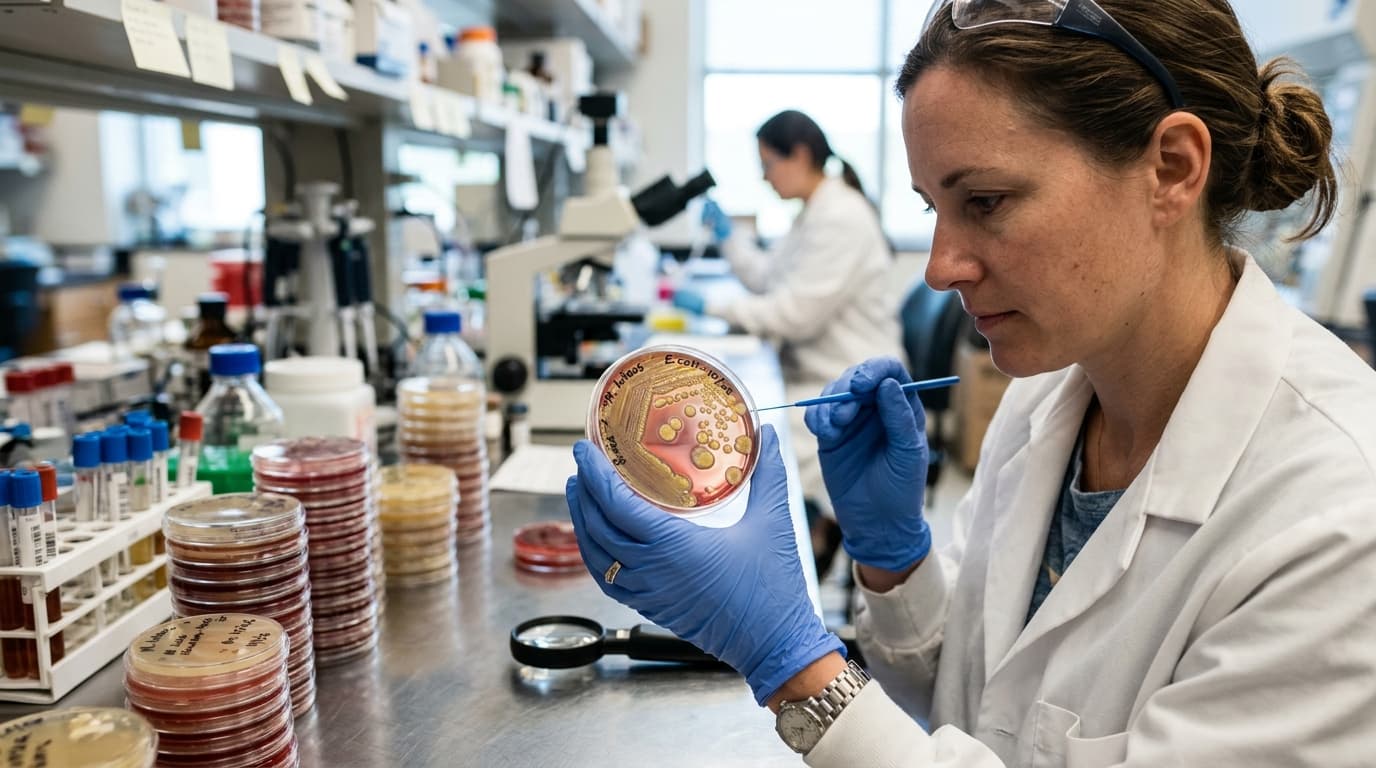
The WHO defines antimicrobial resistance as the phenomenon in which bacteria, viruses, fungi, and parasites stop responding to the medicines designed to fight them, making infections difficult or impossible to treat. In the case of bacteria, MedlinePlus explains that resistance happens when bacteria change and become able to resist the effects of an antibiotic. In other words, the medicine that once killed that bacterium stops working.
The WHO makes an important caveat: resistance is in part a natural process that happens over time through genetic changes in microorganisms. The problem is that human activity greatly accelerates this process. Each time an antibiotic is used, it creates a pressure that favors the survival of the more resistant bacteria. When use is frequent and unnecessary, this pressure rises needlessly, and resistant bacteria multiply and spread.
Why this is one of the greatest threats to global health
The numbers help put the problem in perspective. The WHO estimates that bacterial resistance was directly linked to 1.27 million deaths worldwide in 2019, and contributed to about 4.95 million deaths that same year. The economic projections are also striking: the organization speaks of up to 1 trillion dollars in additional healthcare costs by 2050 and significant annual losses for the world economy in the coming decades. In the United States, the CDC estimates that more than 2.8 million antimicrobial-resistant infections occur each year, with more than 35,000 deaths a year as a result.
What makes resistance so serious is that it threatens to undo gains that today seem guaranteed. The WHO warns that resistance puts many of the advances of modern medicine at risk. Without effective antibiotics, procedures that depend on preventing infections, such as major surgeries, transplants, complicated childbirth, and chemotherapy, become much more dangerous. A common infection, which today is resolved with a simple treatment, may once again become a serious threat.
How incorrect use generates resistance
Understanding the mechanism makes it clear why certain behaviors are so harmful. Resistance does not arise from a single act, but is fed by patterns of inappropriate use that repeat on a large scale. The main ones are:
- Using antibiotics for a viral illness. Taking an antibiotic for the flu or a cold does not treat the illness (which is viral) and still exposes the body's bacteria to the pressure of the medicine, favoring the resistant ones.
- Using without medical indication. Self-medication leads to use in situations where it is not necessary and, often, in the wrong way.
- Stopping or changing the treatment on your own. Altering the course defined by the doctor can leave bacteria alive, and it is precisely the ones that resisted best that tend to survive.
- Using leftovers or someone else's antibiotic. This usually means the wrong medicine, in the wrong situation, feeding resistance without treating the real infection.
- Pressuring for a prescription. Asking the doctor for an antibiotic "just in case," even in a likely viral picture, contributes to the collective problem.
The CDC sums up the central point: any time an antibiotic is used, it can cause side effects and contribute to the development of resistance. In other words, there is no use of an antibiotic that is entirely free of consequences. That is why the watchword of the official campaigns is rational use: use it when there is a real indication, and do not use it when there is not.

Responsible use of antibiotics
The good news is that each person can be part of the solution. Responsible use of antibiotics is not complicated: it is a matter of following a few principles and, above all, trusting the decision to someone trained to make it. Combining the guidance of the NHS and MedlinePlus, these are the practices that make a difference:
- Use antibiotics only with a prescription. Only a health professional can assess whether the infection is bacterial and whether it is indicated. Do not self-medicate.
- Follow the guidance you received exactly. Respect what the doctor defined about how and for how long to use the medicine, without changing it on your own, even if you already feel better. MedlinePlus reinforces following the instructions carefully and finishing the medicine as directed.
- Do not stop or adjust on your own. Any doubt about continuing, stopping, or switching should be taken to the professional who prescribed it.
- Never share antibiotics. Do not use another person's prescription or medicine, nor offer yours to anyone.
- Do not save leftovers for the future. MedlinePlus advises not stockpiling antibiotics for later use. Dispose of leftovers properly.
- Prevent infections. Washing your hands, keeping vaccines up to date, and looking after hygiene reduce the chance of getting sick and, with it, the need for antibiotics. The WHO highlights the prevention of infections as a central piece in the fight against resistance.
Note that none of these practices involves choosing a medicine or adjusting amounts on your own. On the contrary: the thread running through all of them is to return the decision to the one responsible for it, the doctor.
The controlled sale rule in Brazil
In Brazil, concern about the indiscriminate use of antibiotics has become a written rule. The sale of these medicines is controlled by the National Health Surveillance Agency (Anvisa). Resolution RDC 20/2011 is the framework that organizes this control, and it establishes important points for the citizen to understand:
- Mandatory prescription. The prescription of antibiotics must be made by a legally qualified professional. It is not an item that can be bought freely off the shelf.
- Prescription retention. Dispensing occurs through the retention of one copy of the prescription at the pharmacy, while the other goes back to the patient. This allows the recording and monitoring of what was sold.
- Validity of 10 days. The antibiotic prescription is valid throughout the national territory for 10 days from the date of issuance.
- Single use. In general, the prescription is dispensed only once, with exceptions provided for prolonged treatments.
This framework exists for a clear reason: to curb unnecessary use and, with it, to slow resistance. When the sale requires a prescription and the pharmacy records the dispensing, it becomes harder for the antibiotic to be used on impulse, on a counter recommendation, or on one's own initiative. It is the practical translation, in the form of law, of everything that the international sources recommend.
Side effects and the microbiota
Like any medicine, antibiotics have side effects. The most common, according to the NHS and MedlinePlus, are those of the digestive system, such as nausea, vomiting, a feeling of a full stomach, indigestion, and diarrhea. Skin rashes or eruptions are also common and, in some people, fungal infections such as thrush, which can affect the mouth and, like a swollen taste bud, cause discomfort on the tongue.
A point that deserves attention is the effect on the microbiota, the set of bacteria that live naturally in our body, especially in the gut. Much of this bacteria is beneficial and helps with digestion and the defense of the organism. The problem is that the antibiotic does not distinguish between the bacteria that cause the infection and these good bacteria: it can hit both. This helps explain why diarrhea is such a frequent effect, a situation in which keeping up good hydration matters, and why, in some cases, a more serious intestinal infection can arise, linked to the bacterium known as C. difficile, which MedlinePlus cites as a possible complication. It is yet another reason to reserve the antibiotic for when it is truly necessary.
There are also allergic reactions. The NHS notes that some people are allergic to antibiotics, especially penicillin, and that serious reactions, although rare, are an emergency. Signs such as a skin rash, wheezing, chest tightness, difficulty breathing, and swelling of the face or throat require immediate emergency care. For all these reasons, the use of an antibiotic should be supervised by a professional, who advises on what to expect and what to watch for.
Myths and facts about antibiotics
"An antibiotic cures the flu." Myth, and one of the most dangerous. The flu is caused by a virus, and an antibiotic does not act against viruses. Taking it for the flu speeds up nothing and only feeds resistance.
"If the discharge is yellow or green, I need an antibiotic." Myth. The color of the discharge is part of the natural course of many viral illnesses and does not, on its own, indicate a bacterial infection. The doctor is the one who decides.
"I can stop the antibiotic as soon as I feel better." Myth when done on your own. MedlinePlus advises following the prescription to the end, and any change should be discussed with the professional who prescribed it.
"A stronger antibiotic is always better." Myth. There is no "stronger" in the popular sense. There is the appropriate medicine for each situation, and that choice is technical and individual, made by the doctor.
"Resistance is the hospital's problem, not mine." Myth. Resistance spreads in the community, from person to person, and each person's use influences the whole. It is a collective public health problem.
"Using antibiotics judiciously protects everyone." Fact. Rational use preserves the effectiveness of antibiotics for when they are truly needed, for you and for others.
When to see a doctor
The golden rule is simple: in the face of a possible infection, the one who decides about antibiotics is the health professional, never the person themselves. Seek medical evaluation especially in these situations:
- Symptoms of infection that do not improve within the expected time or that worsen.
- Persistent or high fever, especially if accompanied by significant malaise.
- Severe sore throat, with difficulty swallowing or signs the doctor needs to assess.
- Signs of infection in the skin, urine, or other areas that cause concern, which the doctor may investigate with tests such as a complete blood count.
- Any picture in more vulnerable people, such as babies, older adults, pregnant women, and people with chronic diseases or reduced immunity.
And seek emergency care in the face of signs of a serious allergic reaction to a medicine, such as swelling of the face or throat, difficulty breathing, and wheezing, as the NHS warns. The central message is to leave the diagnosis and the decision to treat in the hands of someone trained for it. Resisting the temptation to self-medicate is, in itself, an act of care for your own health and for everyone's.
Summary: what to take from this guide
Antibiotics are valuable medicines that treat bacterial infections by acting on structures that only bacteria have. For this reason, they do not work against viruses, and taking an antibiotic for the flu, a cold, or most sore throats and coughs does not help. Unnecessary and incorrect use feeds antimicrobial resistance, which the WHO points to as one of the greatest threats to global health, linked to more than a million direct deaths a year worldwide. Using antibiotics responsibly means using them only with a prescription, following medical guidance exactly, not stopping or adjusting on your own, not sharing, and not saving leftovers. In Brazil, the sale is controlled by Anvisa, with a mandatory prescription and retention of the prescription. Above all, the decision to use or not use an antibiotic, and which one to use, always belongs to the doctor. This care protects your health, avoids needless side effects, and helps keep antibiotics effective for when they are truly needed, for you and for the next generations.
Frequently asked questions
Do antibiotics treat the flu and a cold?
No. The flu and a cold are caused by viruses, and antibiotics only work against bacteria. The CDC and the NHS are clear: antibiotics do not work against colds, the flu, and most coughs. Taking them in these cases does not speed up recovery, exposes the person to side effects for nothing, and contributes to antimicrobial resistance. In these viral illnesses, treatment focuses on relieving symptoms while the body recovers.
Why do antibiotics not work against viruses?
Because bacteria and viruses are completely different. Bacteria are living cells with their own structures, such as a cell wall and the machinery to grow and multiply, and antibiotics attack precisely those structures. Viruses do not have that machinery: they invade the body's cells to reproduce. Since the antibiotic cannot find the target it attacks in bacteria, it simply has no effect on the virus.
What is antimicrobial resistance?
It is when bacteria, viruses, fungi, or parasites stop responding to the medicines designed to fight them, according to the World Health Organization. In the case of bacteria, they change over time and become able to resist the effect of antibiotics, making common infections harder or even impossible to treat. It is considered one of the greatest threats to global health.
Can I stop the antibiotic when I feel better?
Not on your own. MedlinePlus advises following the prescription to the end, even if you already feel well. The decision to continue, adjust, or end the treatment always belongs to the doctor handling the case. Changing the treatment on your own can leave bacteria alive and favor the return of the infection. When in doubt, talk to the professional who prescribed it.
Can I buy antibiotics without a prescription in Brazil?
No. In Brazil, the sale of antibiotics is controlled. Anvisa resolution RDC 20/2011 requires a prescription from a qualified professional and the retention of one copy of the prescription at the pharmacy. The prescription is valid for 10 days from issuance and, in general, can only be used once. This rule exists precisely to curb unnecessary use and resistance.
I have leftover antibiotics from a previous treatment, can I save them for next time?
No. MedlinePlus advises not saving antibiotics for future use and not using leftovers on your own. Every infection is different, and using the wrong medicine, at the wrong time, or in an incomplete way may not treat the problem and may favor resistance. The best approach is not to share antibiotics and to dispose of leftovers properly.
Can I use someone else's antibiotic if the symptoms are similar?
No. Both the NHS and MedlinePlus warn against ever sharing antibiotics or using another person's prescription. Similar symptoms do not mean the same cause, and only a medical evaluation determines whether there is a bacterial infection and what to do. Using someone else's antibiotic can mask the problem, cause reactions, and contribute to resistance.
Do antibiotics have side effects?
Yes. Like any medicine, they can cause effects such as nausea, vomiting, diarrhea, and skin rash. Some people have allergic reactions, especially to penicillin, and the NHS advises seeking emergency care for signs such as swelling of the face or throat and difficulty breathing. Intestinal infections can also occur. That is why use should be supervised by a professional.
Do antibiotics affect the gut flora?
They can. Besides fighting the bacteria that cause the infection, the antibiotic can hit bacteria that live naturally in the body, such as those in the gut. This helps explain why diarrhea is a common effect and why, in some cases, a more serious intestinal infection can arise. This is another reason to use antibiotics only when there is a real medical indication.
Is antimicrobial resistance only my problem or everyone's?
Everyone's. Resistance is a collective public health problem. Resistant bacteria can spread from person to person and make common treatments less effective for the whole population. The WHO estimates that bacterial resistance was directly linked to 1.27 million deaths in 2019 and contributed to about 4.95 million. That is why each person's responsible use protects the community.
When should I see a doctor instead of self-medicating?
Whenever there is a suspected infection that does not improve, persistent fever, worsening symptoms, or signs of severity. Only a professional can say whether the cause is bacterial and whether an antibiotic is indicated. Self-medicating with antibiotics is discouraged by all official sources, because it can delay the correct diagnosis and worsen resistance.
References
- Antimicrobial resistance (World Health Organization, WHO)
- Antibiotic Use (CDC, U.S. Centers for Disease Control and Prevention)
- Antibiotics (NHS, National Health Service of the United Kingdom)
- Antibiotics (MedlinePlus, U.S. National Library of Medicine)
- Resolution RDC No. 20, of May 5, 2011 (Anvisa, via the Virtual Health Library of the Brazilian Ministry of Health)
Author
Equipe Editorial GuiaDeSaude
The GuiaDeSaude Editorial Team researches and writes content from recognized medical sources (PubMed, Ministry of Health, WHO, Mayo Clinic, among others). All information is checked against at least two sources before publication.