Hair loss and baldness: types, causes, and when to see a dermatologist
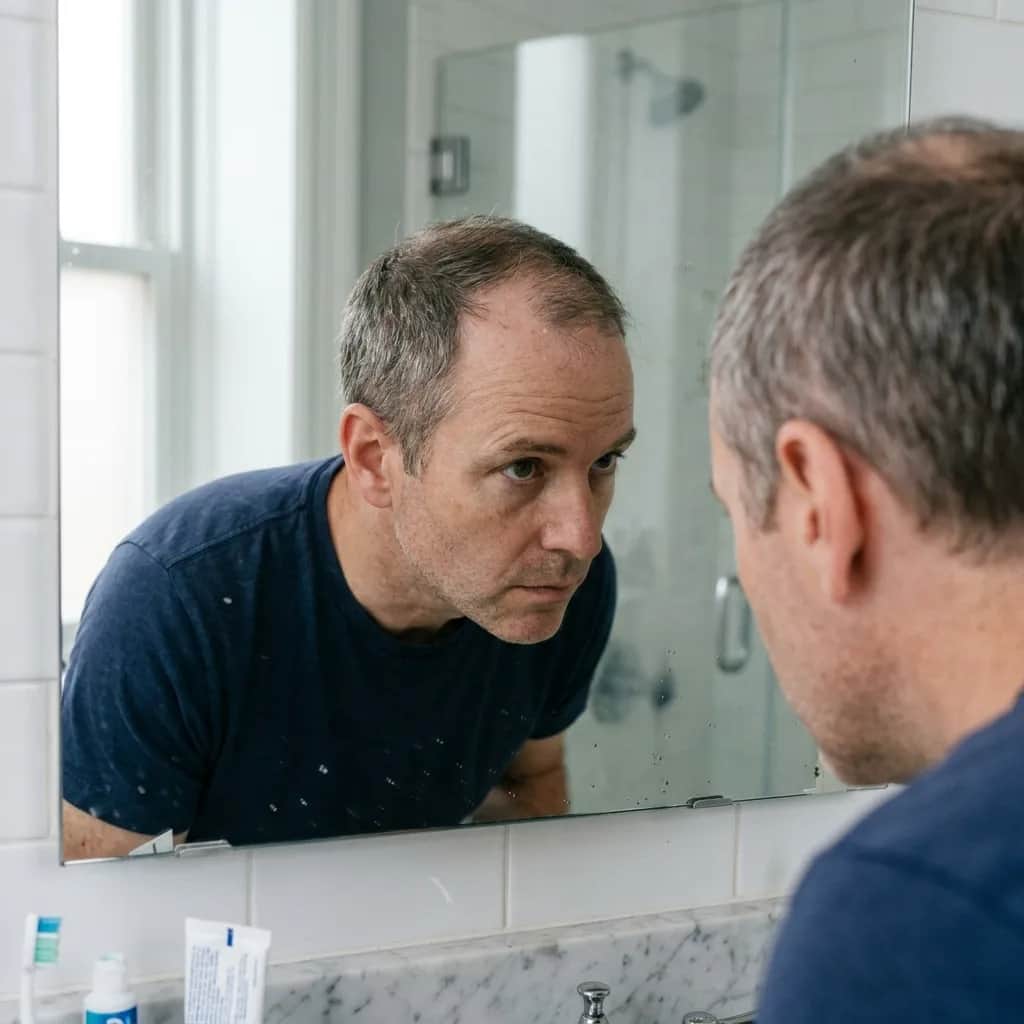
Hair loss is one of the most common health and self-image concerns, affecting both men and women. Finding hairs on your pillow, in the shower drain, or on your comb is unsettling, but the first thing worth knowing is that losing hair every day is part of how the body normally works. What separates natural shedding from loss that deserves investigation is not simply the fact that you see hairs falling, but the amount, the pattern, and what is happening around it. Understanding that difference is what helps you know when to relax and when to see a dermatologist.
This guide was built to be a complete reference on hair loss and baldness. You will understand how much shedding is considered normal, how the hair cycle works, what the main types of loss and baldness are, why they happen, the difference between temporary and permanent loss, how the problem is diagnosed, what care approaches exist, and when it is worth booking an appointment. All of it is based on official sources such as MedlinePlus (from the U.S. National Library of Medicine), the NHS (UK National Health Service), the American Academy of Dermatology (AAD), and the MSD Manuals.
What baldness and hair loss are
Baldness is the popular term for hair loss that leaves areas of the scalp thinner or bare. In medical language, the word used is alopecia, which means the loss or absence of hair in an area where it normally grows. Hair loss, in turn, is a broader term that ranges from the natural day-to-day shedding of hair to processes in which the hair actually stops growing.
There is an important distinction, explained by the American Academy of Dermatology, between two phenomena that many people confuse. One is the shedding of hairs that is part of the natural turnover of hair, in which hairs fall out but keep being replaced by new ones. The other is loss in which something stops the hair from growing, and it only grows back if the underlying cause is resolved. Knowing which of these scenarios you are in is what changes everything, so we will detail each one throughout the text.
How much shedding is normal
This is perhaps the most frequent question, and the answer is reassuring. According to the NHS and the American Academy of Dermatology, it is normal to lose between 50 and 100 hairs a day. MedlinePlus uses a similar figure and states that losing up to about 100 hairs from the scalp per day is normal, and that in most people those hairs grow back. The MSD Manuals give the same range: about 50 to 100 scalp hairs reach the end of the resting phase each day and fall out.
These numbers may seem high, but they make sense when you remember that the scalp has tens of thousands of hairs. Daily loss within this range usually goes unnoticed and does not cause visible gaps. The warning sign is not seeing a few hairs fall, but noticing a clear change from your usual pattern: many more hairs than usual, areas that become thin, or patches that appear.
How the hair cycle works
To understand loss, it helps to know the life cycle of a hair. According to the MSD Manuals, each hair goes through a cycle that has a long growing phase, followed by a brief transitional phase, and then a short resting phase. On the scalp, the growing phase lasts 2 to 6 years. At the end of the resting phase, the hair comes loose and falls out, making room for a new hair to grow in the same follicle.
The interesting point is that each hair is at a different stage of the cycle. While most hairs are growing, a smaller portion is resting and about to fall out. That is why daily shedding is constant and spread out, rather than happening all at once. When something disrupts this cycle, pushing a larger amount of hair into the resting phase at the same time, or preventing new hairs from growing, more noticeable loss appears.
The main types of loss and baldness
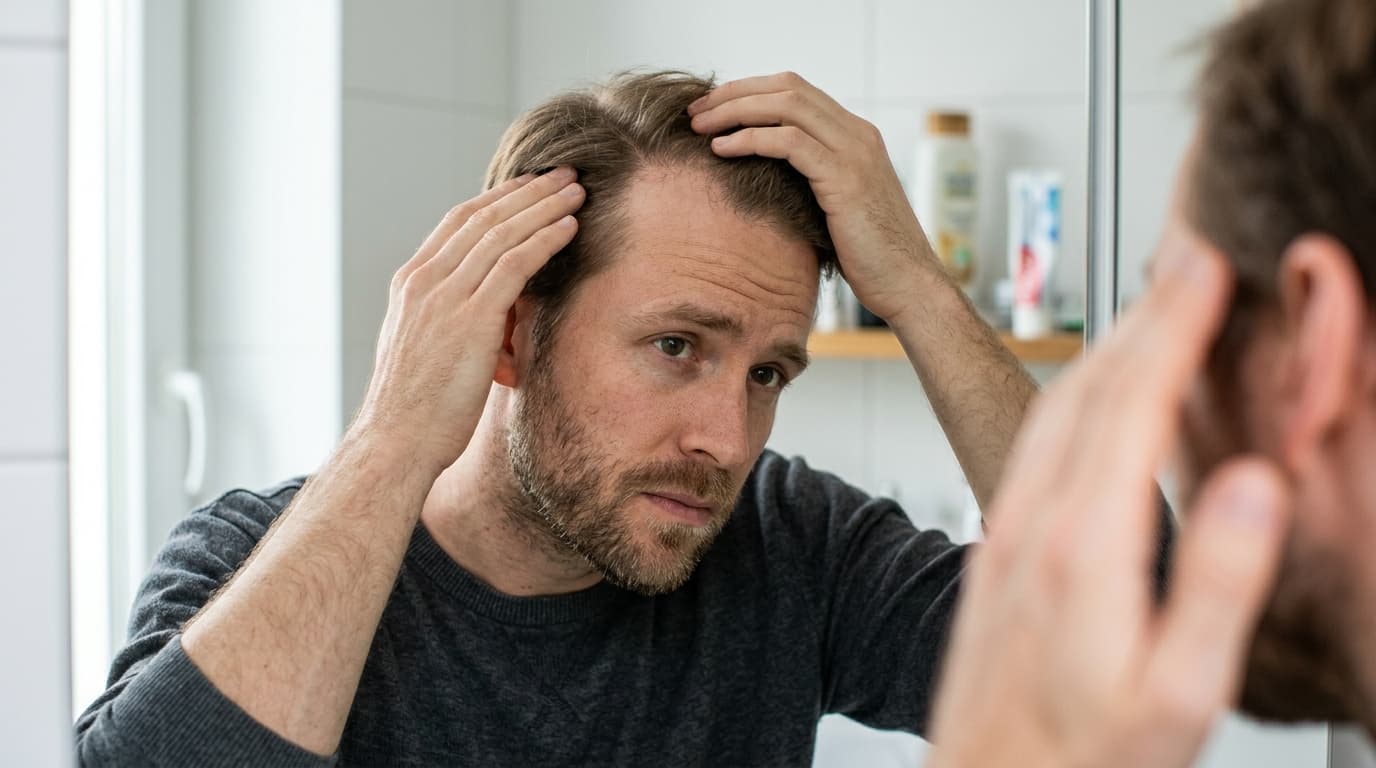
Hair loss is not just one thing. It brings together very different situations, with distinct causes and courses. Knowing the main types helps you understand what may be happening and have a better conversation with the dermatologist.
Androgenetic alopecia (male and female pattern baldness)
This is the most common form of hair loss. The American Academy of Dermatology states plainly that hereditary hair loss, called androgenetic alopecia, is the most common cause of loss worldwide, and that it affects both men and women. It happens when inherited genes cause the follicles to gradually shrink, producing thinner and thinner hairs until they stop producing.
The pattern of loss tends to differ between the sexes. In men, according to the AAD, it usually starts with a receding hairline at the temples and thinning at the top of the head, the so-called crown, forming the well-known male pattern of baldness. In women, the tendency is a more diffuse thinning, with the part widening and the scalp becoming more visible, without necessarily forming fully bare areas. The age of onset varies a great deal, and it may begin in youth or later in life. The NHS classifies male and female pattern baldness as a generally permanent loss.
Telogen effluvium (increased temporary shedding)
Telogen effluvium is an increased but temporary shedding of hair. The American Academy of Dermatology explains that it appears when a trigger pushes a larger amount of hair into the resting phase at the same time, and those hairs fall out a few months later. Among the triggers cited are significant weight loss, childbirth, intense stress, high fever, surgery, and recovery from an illness such as the flu.
The good news is that, in most cases, this type of loss resolves on its own. The AAD notes that within about six to nine months, the hair tends to regain its usual fullness, once the underlying cause is controlled. Here is the practical difference the Academy highlights: in telogen effluvium, the hair keeps growing normally, the body simply sheds more than usual. In loss where something stops the hair from growing, the hair only grows back after the cause is treated.
Alopecia areata
Alopecia areata is a form of loss in which the body's defense system affects the hair follicles, cited by both MedlinePlus and the American Academy of Dermatology. It usually appears as round, well-defined, coin-sized patches on the scalp, and can also affect the beard, eyebrows, and other hair-bearing areas. Its course is quite variable: in some people the hair grows back, in others the patches persist or recur. Because of this unpredictability and its emotional impact, it is a situation that deserves specialist evaluation.
Other causes of loss
Beyond these three major groups, the American Academy of Dermatology lists a series of other causes of hair loss, among them loss after cancer treatment, traction from very tight hairstyles (traction alopecia), scalp infections, effects of certain medications, thyroid disease, hormonal imbalances such as polycystic ovary syndrome, the act of pulling out one's own hair, and a lack of certain nutrients. Each of these situations has its own management, which reinforces why a correct diagnosis is so important.
Comparison table of the main types
| Feature | Androgenetic alopecia | Telogen effluvium | Alopecia areata |
|---|---|---|---|
| What it is | Hereditary loss, linked to genes and hormones | Increased, temporary shedding | Loss in which the body's defense affects the follicles |
| Pattern | Receding hairline and crown in men, diffuse thinning in women | Diffuse loss across the whole scalp | Round, well-defined patches |
| Onset | Gradual, over the years | A few months after a trigger | Can be rapid, with patches appearing |
| Tends to be | Generally permanent, per the NHS | Generally temporary, recovers in months | Variable, unpredictable |
| Typical trigger | Genetic predisposition and hormones | Childbirth, surgery, fever, stress, weight loss | Not fully understood |
| What to do | Dermatologist evaluation | Treat the cause and await recovery | Specialist evaluation |
Causes and risk factors
Bringing together the information from the official sources, hair loss can stem from several factors, which sometimes combine. Knowing this list helps you understand that the problem rarely has a single explanation.
- Heredity and age. The most common cause of loss worldwide is androgenetic alopecia, linked to inherited genes. Both MedlinePlus and the AAD point out that many men, and some women, lose hair as they grow older.
- Hormones. Hormonal changes influence the hair. The AAD cites hormonal imbalances, such as polycystic ovary syndrome, among the causes of loss, and the period after childbirth is a classic trigger of telogen effluvium. Hormonal fluctuations are also behind other common complaints, such as PMS.
- Physical and emotional stress. Intense stress, surgeries, high fever, and recovery from illness can trigger telogen effluvium. MedlinePlus cites psychological stress among the causes of loss, and the same stress can feed other complaints, such as a tension-type headache.
- Illnesses. Thyroid problems, diabetes, and autoimmune diseases such as lupus are among the conditions that can cause loss, according to MedlinePlus and the AAD. Scalp infections also belong on this list.
- Medications and treatments. Certain medications can have loss as a side effect, and chemotherapy for cancer treatment is a well-known cause, cited by both sources.
- Nutrition. The AAD lists a lack of protein, iron, zinc, and biotin among the possible causes, and the NHS mentions iron deficiency. MedlinePlus points to poor nutrition and a diet low in protein. A balanced diet also supplies minerals such as those in foods high in phosphorus and nutrients like vitamin D.
- Care and hairstyles. Repeated chemical treatments, excessive heat, and very tight hairstyles that constantly pull on the hair can damage the hair and lead to traction loss.
Difference between temporary and permanent loss
This is one of the most useful distinctions in the whole subject. Some types of loss are temporary and reversible, while others tend to be permanent.
Temporary loss is generally linked to an identifiable trigger, such as an illness, surgery, childbirth, significant weight loss, intense stress, or iron deficiency. The classic example is telogen effluvium, in which the hair usually regains its fullness after the cause is resolved. In these cases the hair is still able to grow, it just fell out in greater amounts for a period.
Male and female pattern baldness, according to the NHS, tends to be permanent, because the follicles progressively shrink. It is worth remembering that these patterns can coexist: a person with a genetic predisposition can also go through an episode of telogen effluvium after a stressful event. So, rather than trying to guess at home, the safest path is an evaluation by a dermatologist, who can tell the scenarios apart.
Myths and facts about hair loss
"Wearing a cap causes baldness." Myth. The most common cause of baldness is hereditary, linked to genes and hormones, not to wearing a cap or hat. What can contribute to traction loss are very tight hairstyles pulling on the hair for long periods, which is different from ordinary use of an accessory.
"Washing your hair often makes it fall out more." Myth. The hairs that appear in the drain while washing are usually part of the day's natural shedding. The AAD explains that seeing hairs fall in the shower is generally part of the normal turnover of hair, not a consequence of the act of washing.
"Cutting your hair makes it grow back stronger." Myth. Cutting acts on the hair that is already outside the scalp and does not change the follicle, which is where the hair grows. Cutting can improve appearance, but it does not change density or growth speed.
"Baldness comes only from the mother (or only from the father)." A simplistic myth. Androgenetic alopecia has a hereditary component, but it does not come exclusively from one side of the family. Inheritance is more complex than that popular idea suggests.
"Stress can increase loss." Fact. Intense stress is a recognized trigger of telogen effluvium, cited by the AAD, and psychological stress appears among the causes listed by MedlinePlus.
"There is a product that guarantees regrowing all your hair." Myth, and a warning. The NHS states plainly that no treatment is 100% effective. Be wary of any promise of a guarantee.
How the diagnosis is made
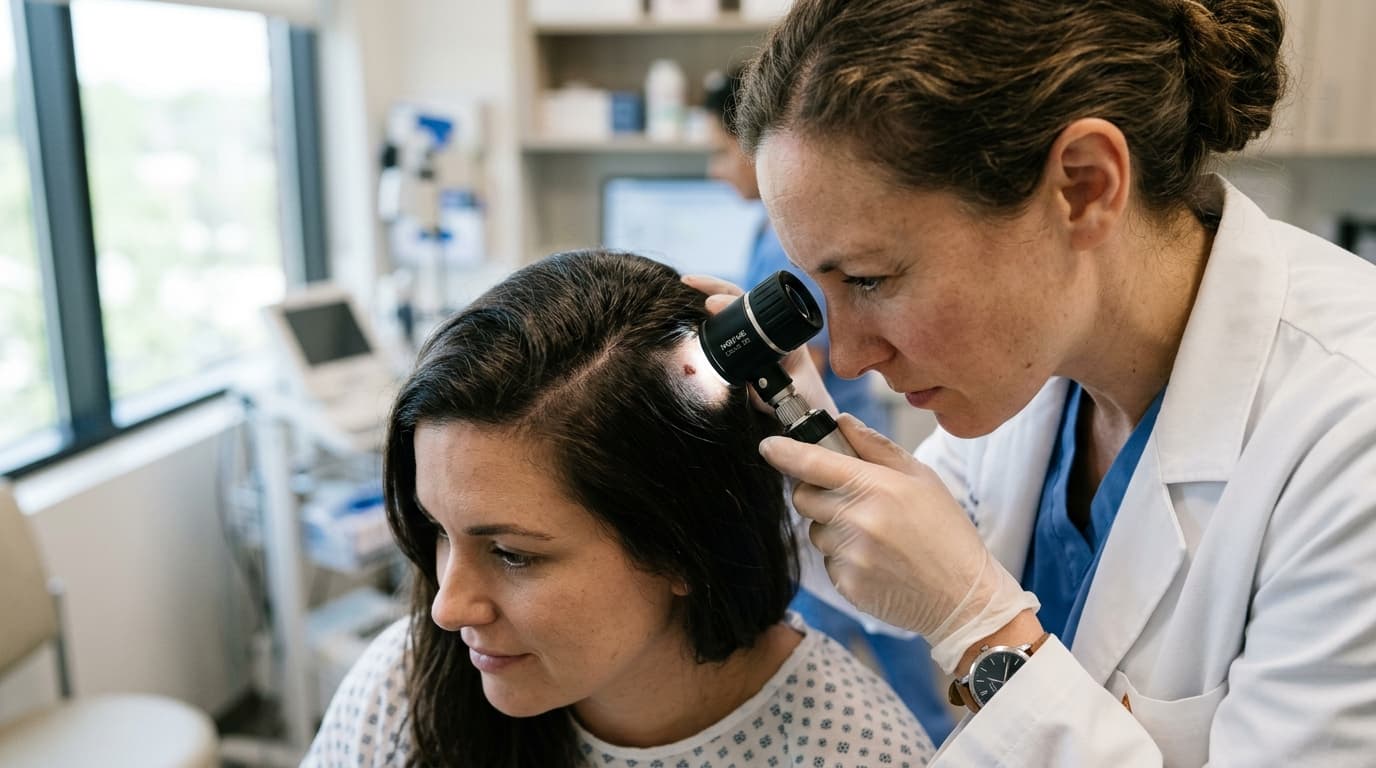
There is no single test that settles the diagnosis of all hair loss. The evaluation begins with the consultation with the dermatologist, who usually asks how long the loss has been going on, how it has progressed, what the pattern is (diffuse or patchy), whether there are cases of baldness in the family, what medications you take, how your diet has been, and whether there have been recent events, such as illnesses, surgeries, childbirth, or weight loss. This history alone already guides much of the reasoning.
The professional also examines the scalp and the hair, observing the pattern of thinning, the presence of patches, and the appearance of the skin. In some situations, blood tests may be requested, such as a complete blood count, for example to investigate the thyroid, iron deficiency, or other conditions, depending on the suspicion. The decision about which tests to order, and whether they are necessary, belongs to the professional who assesses each case. As the AAD reminds us, the dermatologist is the one who can distinguish between temporary loss and loss in which growth has been interrupted, and that difference completely changes the approach.
Treatment and care approaches
Treatment of hair loss depends entirely on the cause and the type, and should be defined by a doctor. There is no single recipe that works for everyone, and any approach must be individualized. In general terms, the official sources point to a few paths.
In many cases, according to MedlinePlus, treating the underlying cause already corrects the problem. When loss is caused by thyroid disease, a nutrient deficiency, a medication, or a period of stress, controlling that cause usually allows the hair to recover, as happens in telogen effluvium. In these scenarios, the doctor's focus is to identify and treat what is behind it.
For hereditary pattern baldness, there are specific options. The NHS mentions that finasteride and minoxidil are among the main treatments for male pattern baldness, and also cites procedures such as hair transplants, along with options such as wigs and, in some cases, steroid injections for certain types of loss. It is essential to understand that the choice of any treatment, including the indication, how it is used, and follow-up, is the doctor's responsibility. This guide does not recommend doses or products.
One point worth highlighting, out of the source's own honesty: the NHS states that no treatment is 100% effective. In other words, no approach guarantees regrowing all your hair. This information is important for setting realistic expectations and for protecting you from exaggerated promises. Supplements, formulas, and products sold with the promise of bringing hair back should be viewed with great caution, and nothing should be started without professional guidance.
What helps with day-to-day care
While the cause is investigated and treated, some general care helps preserve the hair you have, without promising to make hair grow where it stopped growing.
- Treat your hair gently. Avoid very tight hairstyles that pull on the hair for long periods, since repeated traction is a cause of loss cited by the AAD.
- Be careful with excessive heat and chemicals. Repeated chemical treatments and heavy use of heat can damage and weaken the hair.
- Maintain a balanced diet. Since a lack of protein, iron, zinc, and biotin appears among the possible causes of loss, a varied and adequate diet helps, including staying well hydrated. This does not mean taking supplements on your own, which should only be used with guidance.
- Manage stress when possible. Since intense stress is a trigger of telogen effluvium, relaxation techniques, adequate sleep (and addressing any insomnia), and physical activity are part of general health care.
- Do not turn to miracle formulas. The NHS advises seeing a professional rather than turning first to commercial clinics, and reminds us that no treatment is 100% effective.
When to see a dermatologist
Most hair loss does not pose a health risk, but there are situations in which it is worth booking an appointment without putting it off. The NHS advises seeing a professional if you are worried about your loss, rather than turning first to commercial clinics. Bringing together the guidance from the sources, it is worth seeking an evaluation when:
- The loss clearly changes from your usual pattern, with many more hairs falling than normal.
- Round, well-defined patches appear on the scalp, the beard, or the eyebrows.
- The loss comes with other symptoms, such as itching, pain, scaling, or redness on the scalp.
- The loss begins shortly after starting a new medication.
- The loss is bothering you, affecting your self-esteem or quality of life.
- The hair comes out in clumps or very rapidly.
The dermatologist is the right professional to investigate the cause, distinguish the types of loss, and guide the appropriate care for your case. The sooner the cause is identified, the sooner it can be acted on, especially in reversible loss.
Summary: what to take from this guide
Losing between 50 and 100 hairs a day is normal and part of the natural hair cycle, in which each hair goes through growing, transitional, and resting phases. The sign that deserves attention is not seeing hairs fall, but a clear change in your usual pattern or the appearance of patches. The most common cause of baldness is androgenetic alopecia, hereditary and generally permanent, while telogen effluvium is a temporary loss linked to triggers such as childbirth, surgery, fever, stress, and weight loss, which usually recovers. Alopecia areata, in which the body's defense affects the follicles, and other causes, such as thyroid disease and nutritional deficiencies, complete the picture. A correct diagnosis, made by a dermatologist, is what defines the path, because treatment depends on the cause. Two central messages are worth keeping: no treatment is 100% effective, according to the NHS, so be wary of promises of full recovery, and seeking professional guidance, rather than formulas without follow-up, is the safest step to care for your hair.
Frequently asked questions
How many hairs is it normal to lose per day?
Losing between 50 and 100 hairs a day is considered normal, according to the NHS and the American Academy of Dermatology. MedlinePlus cites up to about 100 hairs a day. In most people those hairs grow back, because shedding is part of the natural hair cycle. What deserves attention is a clear change from your usual pattern.
Is male pattern hair loss hereditary?
Most of the time, yes. The American Academy of Dermatology describes hereditary hair loss, called androgenetic alopecia, as the most common cause of hair loss worldwide, in both men and women. It happens when inherited genes cause the follicles to gradually shrink and stop producing hair.
What is the difference between temporary loss and permanent baldness?
Some types of loss are temporary, such as telogen effluvium, which usually resolves once the underlying cause is controlled. Male and female pattern baldness, according to the NHS, tends to be permanent. The best way to know which situation you are in is an evaluation by a dermatologist, because the patterns can overlap.
What is telogen effluvium?
It is an increased and temporary shedding of hair, described by the American Academy of Dermatology. It usually appears a few months after a trigger, such as surgery, high fever, childbirth, significant weight loss, intense stress, or an illness. In most cases the hair regains its usual fullness over a few months, once the trigger is resolved.
What is alopecia areata?
It is a form of hair loss in which the body's defense system affects the follicles, mentioned by MedlinePlus and the American Academy of Dermatology. It usually appears as round, well-defined patches on the scalp, and can also affect the beard and other areas. The course varies a great deal from person to person and should be assessed by a dermatologist.
Can stress cause hair loss?
It can, especially in the form of telogen effluvium. The American Academy of Dermatology lists intense stress, alongside events such as childbirth, illness, and surgery, among the triggers of increased and temporary shedding. MedlinePlus also cites psychological stress among the causes of hair loss. In general, this kind of loss tends to improve once the situation is under control.
Do vitamin or iron deficiencies cause hair loss?
In some situations, yes. The American Academy of Dermatology lists a lack of protein, iron, zinc, and biotin among the possible causes of loss, and the NHS cites iron deficiency. This does not mean that taking supplements on your own will solve it. Investigating and deciding whether to replace any nutrient should come from a professional.
Does wearing a cap cause baldness?
There is no basis for that idea. The most common cause of baldness is hereditary, linked to genes and hormones, not to wearing a cap or hat. What can contribute to some types of loss is repeated traction, such as very tight hairstyles pulling on the hair for long periods, which is different from ordinary cap use.
Does washing your hair every day make it fall out more?
The hairs you see in the drain while washing are generally part of the day's natural shedding and are not caused by the act of washing. The American Academy of Dermatology explains that seeing hairs fall in the shower is usually part of the normal turnover of hair. What can damage hair are aggressive practices, such as repeated chemical treatments and excessive heat.
Is there a cure or treatment that guarantees regrowing all your hair?
There is no serious promise of regrowing all your hair. The NHS states plainly that no treatment is 100% effective. What exists are approaches, defined by a doctor according to the cause and the type of loss. So be wary of any product or formula that promises guaranteed results, and talk to a dermatologist before starting any treatment.
When should I see a dermatologist about hair loss?
It is worth seeking an evaluation when the loss changes from your usual pattern, when patches appear on the scalp, when the loss comes with other symptoms, when it appears after starting a medication, or when it is bothering you. The NHS advises seeing a professional if you are worried about the loss, rather than turning first to commercial clinics.
Is baldness related to age?
It is. Both MedlinePlus and the American Academy of Dermatology note that many men, and some women, lose hair as they grow older. In androgenetic alopecia, the loss tends to increase gradually over the course of life, and the age at which it starts varies a great deal from person to person.
Author
Equipe Editorial GuiaDeSaude
The GuiaDeSaude Editorial Team researches and writes content from recognized medical sources (PubMed, Ministry of Health, WHO, Mayo Clinic, among others). All information is checked against at least two sources before publication.